


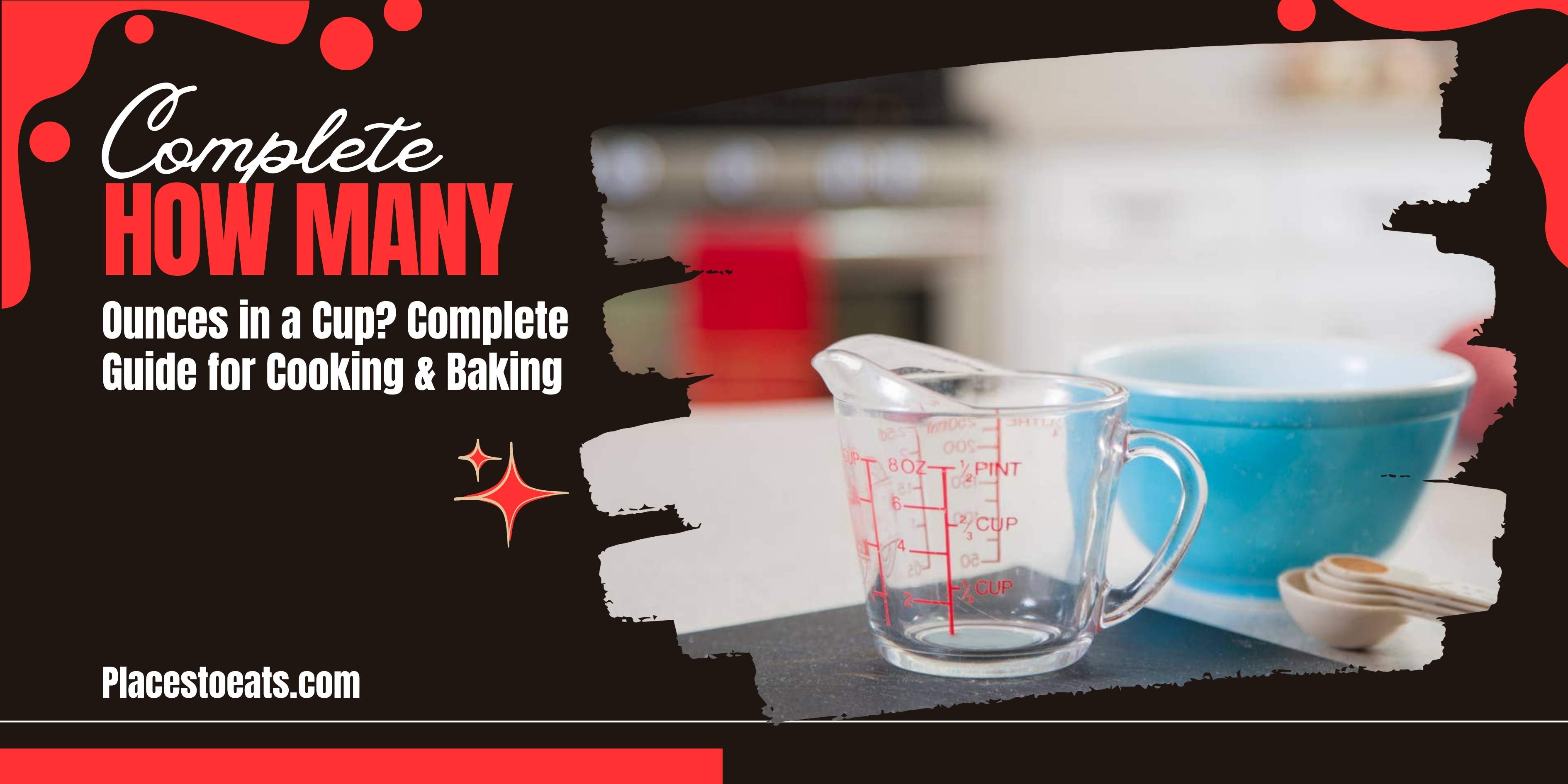

You are mid-recipe. The measuring jug shows ounces but the recipe says cups. Or the other way around. Either way, you need an answer fast and you need the right one, because in baking especially, getting it wrong can ruin everything.
This guide answers how many ounces in a cup for every situation: liquids, dry ingredients, half cups, quarter cups, and specific ingredients like flour, sugar, coffee, and milk. We also cover the difference between US and UK cups, and explain why fluid ounces and dry ounces are not the same thing.
☕ Cups to Ounces Calculator
PlacesToEats.com Instant kitchen conversions for cooking & baking
🔢 Custom Converter Enter Any Amount
📊 Complete Cups to Ounces Conversion Table
| Cups | Fluid Ounces (fl oz) | Milliliters (ml) | Tablespoons |
|---|---|---|---|
| ⅛ cup | 1 fl oz | 29.6 ml | 2 tbsp |
| ¼ cup | 2 fl oz | 59.1 ml | 4 tbsp |
| ⅓ cup | 2.67 fl oz | 78.9 ml | 5⅓ tbsp |
| ½ cup | 4 fl oz | 118.3 ml | 8 tbsp |
| ⅔ cup | 5.33 fl oz | 157.7 ml | 10⅔ tbsp |
| ¾ cup | 6 fl oz | 177.4 ml | 12 tbsp |
| 1 cup | 8 fl oz | 236.6 ml | 16 tbsp |
| 1¼ cups | 10 fl oz | 295.7 ml | 20 tbsp |
| 1½ cups | 12 fl oz | 354.9 ml | 24 tbsp |
| 1¾ cups | 14 fl oz | 414 ml | 28 tbsp |
| 2 cups | 16 fl oz | 473.2 ml | 32 tbsp |
| 3 cups | 24 fl oz | 709.8 ml | 48 tbsp |
| 4 cups (1 quart) | 32 fl oz | 946.4 ml | 64 tbsp |
| 6 cups | 48 fl oz | 1,419.5 ml | 96 tbsp |
| 8 cups (½ gallon) | 64 fl oz | 1,892.7 ml | 128 tbsp |
| 16 cups (1 gallon) | 128 fl oz | 3,785.4 ml | 256 tbsp |
🥄 How Many Ounces in a Cup By Ingredient
Dry ounces measure weight they vary by ingredient density
| Ingredient | 1 Cup = ? oz (weight) | Notes |
|---|---|---|
| All-purpose flour | 4.25 oz | Spooned & leveled |
| Bread flour | 4.5 oz | Slightly denser |
| Whole wheat flour | 5 oz | Heavier than AP |
| Cake flour | 3.5 oz | Very light |
| Granulated sugar | 7.1 oz | Consistent |
| Brown sugar (packed) | 7.5–8 oz | Pack tightly |
| Powdered sugar | 4 oz | Sifted |
| Cocoa powder | 3–3.3 oz | Unsweetened |
| Cornstarch | 3.5–4.8 oz | Varies by packing |
| Baking soda | 9.6 oz | Very dense |
| Butter (melted) | 8 oz | Same as fl oz! |
| Liquid | 1 Cup = fl oz | Weight Notes |
|---|---|---|
| Water | 8 fl oz | 8.34 oz by weight |
| Milk (whole) | 8 fl oz | ~8.6 oz by weight |
| Heavy cream | 8 fl oz | ~8.2 oz by weight |
| Honey | 8 fl oz | 12 oz by weight very heavy! |
| Olive oil | 8 fl oz | 7.5 oz by weight |
| Vegetable oil | 8 fl oz | 7.4 oz by weight |
| Coffee (brewed) | 8 fl oz | Standard coffee mug = 1 cup |
| Orange juice | 8 fl oz | ~8.6 oz by weight |
| Maple syrup | 8 fl oz | 11.4 oz by weight |
| Vinegar | 8 fl oz | ~8.2 oz by weight |
| Ingredient | 1 Cup = ? oz (weight) | Notes |
|---|---|---|
| White rice (uncooked) | 6.5–7 oz | |
| Brown rice (uncooked) | 7 oz | |
| Rolled oats | 3–3.5 oz | Light and airy |
| Quinoa (dry) | 6.3 oz | |
| Breadcrumbs (dry) | 3.5 oz | |
| Chocolate chips | 6–6.3 oz | |
| Whole almonds | 6.7 oz | |
| Chopped walnuts | 4 oz | |
| Shredded coconut | 3 oz | Very light |
| Cream cheese | 9 oz | Dense |
🌍 Cup Sizes Around the World
Quick Answer: How Many Ounces in a Cup?
1 US cup = 8 fluid ounces (fl oz)
That is the answer for every liquid water, milk, broth, juice, oil, cream. If you are measuring a liquid, 1 cup always equals 8 fluid ounces, no exceptions.
| Cup Amount | Fluid Ounces | Milliliters |
| ¼ cup | 2 fl oz | 59 ml |
| ⅓ cup | 2.67 fl oz | 79 ml |
| ½ cup | 4 fl oz | 118 ml |
| ¾ cup | 6 fl oz | 177 ml |
| 1 cup | 8 fl oz | 237 ml |
| 2 cups | 16 fl oz | 473 ml |
| 4 cups | 32 fl oz | 946 ml |
For dry ingredients, the answer is different and that is where most cooks get confused. Keep reading.
Fluid Ounces vs Dry Ounces What Is the Difference?
This is the most important thing to understand, and it is the thing most people get wrong.
What Are Fluid Ounces (fl oz)?
Fluid ounces measure volume how much space a liquid takes up. When you fill a measuring cup with water to the 1-cup line, that is 8 fluid ounces. The number stays the same regardless of what liquid you are measuring, because you are measuring how much space it fills, not how heavy it is.
What Are Dry Ounces (oz)?
Dry ounces measure weight how heavy something is. When a baking recipe says “4.25 oz of flour,” it means the flour should weigh 4.25 ounces on a kitchen scale, regardless of how much volume it takes up in a cup.
Why They Are Not the Same Thing
Here is the confusion: a cup of water happens to weigh almost exactly 8 ounces. So for water, the fluid ounce volume and the weight ounce are nearly identical. But for almost every other ingredient, they diverge completely:
| Ingredient | 1 Cup Volume | 1 Cup Weight |
| Flour | 8 fl oz | 4.25 oz |
| Honey | 8 fl oz | 12 oz |
| Sugar | 8 fl oz | 7.1 oz |
The reason: different ingredients have different densities. Honey is heavy and thick. Flour is light and airy. A cup-sized space holds very different weights of each.
Rule to remember: If your recipe says “fl oz” or is a liquid use your measuring cup. If your recipe says “oz” for a dry ingredient use a kitchen scale.
Cups to Ounces Conversion Chart All Sizes
How Many Ounces in Half a Cup?
½ cup = 4 fluid ounces = 118 ml = 8 tablespoons
Half a cup is one of the most searched conversions because it comes up constantly in recipes for sauces, dressings, and baking. Four fluid ounces. Easy to remember.
How Many Ounces in a Quarter Cup?
¼ cup = 2 fluid ounces = 59 ml = 4 tablespoons
A quarter cup is 2 fluid ounces. If you do not have a ¼ cup measure, use 4 tablespoons it is the exact same amount.
How Many Ounces in a Third Cup?
⅓ cup = 2.67 fluid ounces = 79 ml ≈ 5 tablespoons + 1 teaspoon
The third cup is awkward because 8 does not divide evenly by 3. If precision matters, use a measuring cup marked for ⅓. If you are estimating, 2⅔ oz is close enough for most savory recipes.
How Many Ounces in 2 Cups?
2 cups = 16 fluid ounces = 473 ml = 1 pint
Two cups equals one pint. This comes up often when a recipe calls for a pint of stock, cream, or berries. 16 fluid ounces.
How Many Ounces in 4 Cups?
4 cups = 32 fluid ounces = 946 ml = 1 quart
Four cups equals one quart. Recipes for soups, stews, and large batches often use quarts. 32 fluid ounces.
How Many Ounces in 8 Cups?
8 cups = 64 fluid ounces = 1.89 liters = ½ gallon
Eight cups is half a gallon. A standard large water bottle or blender jug typically holds about 8 cups.
How Many Ounces in a Cup By Ingredient
This is the section no competitor gives you properly. Liquids are always 8 fluid ounces per cup but the weight in dry ounces changes with every ingredient. Here is the full breakdown.
How Many Ounces in a Cup of Water
1 cup of water = 8 fluid ounces = 8.34 oz by weight
Water is the only ingredient where fluid ounces and weight ounces are almost the same. For all practical cooking purposes, treat 1 cup of water as 8 ounces in both measurements.
How Many Ounces in a Cup of Flour
1 cup of all-purpose flour = 4.25 oz by weight (NOT 8)
This surprises many home bakers. A cup of flour looks like 8 ounces of volume but weighs only 4.25 ounces. The reason: flour is light and porous there is a lot of air in that cup.
Flour type changes the weight slightly:
– All-purpose flour: 4.25 oz per cup
– Bread flour: 4.5 oz per cup
– Whole wheat flour: 5 oz per cup
– Cake flour: 3.5 oz per cup (lightest of all)
For consistent baking results, professional bakers always weigh flour rather than measuring by cup, because how you scoop flour into the cup changes the weight by up to 20%.
How Many Ounces in a Cup of Sugar
1 cup of granulated sugar = 7.1 oz by weight
Sugar is significantly denser than flour, which is why a cup of sugar weighs much more 7.1 oz compared to flour’s 4.25 oz.
Sugar types by weight per cup:
– Granulated (white) sugar: 7.1 oz
– Brown sugar (packed firmly): 7.5–8 oz
– Powdered (icing) sugar: 4 oz
– Caster sugar: 7 oz
How Many Ounces in a Cup of Butter
1 cup of butter = 8 oz by weight = 2 sticks of butter (US)
Butter is one of the few ingredients where volume and weight actually align. One cup of butter weighs 8 ounces, same as its fluid ounce volume. Two US sticks of butter equals 1 cup, 8 oz, 16 tablespoons.
How Many Ounces in a Cup of Milk
1 cup of milk = 8 fluid ounces = 8.6 oz by weight
Milk is slightly heavier than water because of its fat and protein content. For recipe purposes, treat 1 cup of milk as 8 fluid ounces the small weight difference does not matter in cooking.
How Many Ounces in a Cup of Coffee
1 cup of brewed coffee = 8 fluid ounces
This is a common source of confusion because most coffee mugs hold 10 to 12 fluid ounces, not 8. A “cup” of coffee in a recipe or measurement context means 8 fluid ounces but a standard coffee mug is not a measuring cup.
When a recipe calls for 1 cup of brewed coffee, use a proper measuring cup filled to the 8 oz line not a regular coffee mug, which will give you too much.
How Many Ounces in a Cup of Honey
1 cup of honey = 8 fluid ounces by volume = 12 oz by weight
Honey is one of the heaviest common cooking ingredients. Its extreme density means 1 cup of honey weighs 12 oz half again as much as the same volume of water. This matters when substituting honey for sugar in recipes.
How Many Ounces in a Cup of Rice
1 cup of uncooked white rice = 6.5–7 oz by weight
1 cup of uncooked brown rice = 7 oz by weight
Rice is measured by volume in recipes, so the cup-to-oz weight mainly matters if you are scaling a recipe by weight rather than volume.
US Cup vs UK Cup vs Metric Cup Which One Is in Your Recipe?
Not all cups are 8 ounces. If you are following a recipe from another country, the cup size may be different from what you expect.
US Customary Cup (8 fl oz)
The standard in American recipes. 1 cup = 8 fluid ounces = 236.6 ml. This is what all US cookbooks use.
US Legal Cup Nutrition Labeling (240 ml)
Used on US food packaging and nutrition labels. Slightly larger than the cooking cup. 1 legal cup = 8.12 fl oz = 240 ml. The difference from the customary cup is tiny and does not matter in recipes.
UK Imperial Cup (10 fl oz)
Older British recipes use a larger cup. 1 UK imperial cup = 10 fluid ounces = 284 ml. This cup is 25% larger than the US cup a significant difference in baking. Most modern UK recipes have moved away from cup measurements entirely and use grams instead.
Metric Cup Australia and Canada (250 ml)
Australia and Canada use a metric cup of 250 ml = 8.45 fl oz. This is about 5.7% larger than the US cup. For most savory cooking it does not matter. For baking, it can affect results, especially for flour.
Japanese Cup (200 ml)
Japanese recipes use a cup of 200 ml = 6.76 fl oz, significantly smaller than the US cup. If you are following a Japanese recipe, be careful with cup measurements.
Practical tip: If a recipe comes from outside the US, check which cup standard they use. When in doubt, use grams and milliliters they are the same everywhere.
5 Common Measurement Mistakes Cooks Make
Mistake 1 Using a Dry Measuring Cup for Liquids
Dry measuring cups are designed to be filled to the brim and leveled off. For liquids, this makes it very easy to spill and almost impossible to read accurately. Always use a liquid measuring cup (the kind with a spout and measurement markings on the side) for any liquid ingredient.
Mistake 2 Packing Flour Too Tight in the Cup
Scooping a measuring cup directly into a flour bag compacts the flour, which can add 20-30% more flour than the recipe intended. The correct method is to spoon flour into the cup and level with a straight edge never scoop directly.
Mistake 3 Confusing fl oz and oz on a Recipe
A recipe that says “8 oz of cream cheese” means 8 weight ounces about 1 cup. A recipe that says “8 fl oz of cream” means 8 fluid ounces 1 cup by volume. These are usually the same amount but for different reasons, and for denser or lighter ingredients, the difference becomes larger.
Mistake 4 Not Checking for UK vs US Recipe Differences
A recipe from a British cookbook calling for “1 cup of flour” in an older edition likely means 10 fl oz, not 8. Using a US cup instead of a UK cup means you are adding 20% less flour than intended. Always check the recipe source country and cup standard used.
Mistake 5 Trusting a Coffee Mug as a Cup Measure
A standard coffee mug holds 10 to 16 fluid ounces not 8. Using a mug to measure liquids in a recipe will give you more than you need every time. Use a proper measuring cup.
When to Use a Kitchen Scale Instead of Cups
For most everyday cooking soups, stews, stir-fries, sauces cup measurements work perfectly well. But for baking, a kitchen scale gives you far more consistent results.
Use a scale when:
– Baking bread, pastry, or cakes where exact flour amounts matter
– A recipe gives weights in grams or ounces rather than cups
– You are scaling a recipe up or down
– You are using an international recipe that uses metric measurements
– You want consistent results every time you bake the same recipe
A basic digital kitchen scale costs very little and takes the guesswork out of dry ingredient measurements entirely. Many professional bakers stopped using cups for dry ingredients years ago.
Frequently Asked Questions About Ounces in a Cup
Is 8 oz always equal to 1 cup?
For liquids, yes 8 fluid ounces always equals 1 cup in the US system. For dry ingredients measured by weight, no 8 weight ounces does not always equal 1 cup because different ingredients have different densities.
How many fluid ounces in a cup?
1 US cup = 8 fluid ounces exactly. This is fixed for all liquids in the US measurement system.
How many dry ounces in a cup?
It depends entirely on the ingredient. A cup of flour weighs 4.25 oz. A cup of sugar weighs 7.1 oz. A cup of honey weighs 12 oz. There is no single answer for dry ounces it changes with every ingredient.
How many ounces in a half cup?
Half a cup equals 4 fluid ounces, 118 milliliters, or 8 tablespoons.
How many ounces in a quarter cup?
A quarter cup equals 2 fluid ounces, 59 milliliters, or 4 tablespoons.
Does 1 cup of coffee equal 8 ounces?
Yes, in measurement terms. 1 cup of brewed coffee = 8 fluid ounces. However, most coffee mugs hold 10–16 oz, which is more than one cup.
How many ounces in 4 cups?
Four cups equals 32 fluid ounces, which is also 1 quart.
Why does my recipe use grams instead of cups?
Grams are more precise than cups for dry ingredients, and they are the same in every country. Many bakers and international recipes prefer grams because there is no ambiguity 200g of flour is 200g anywhere in the world.
Summary How Many Ounces in a Cup
| Measurement | US Standard | Notes |
| 1 Cup (liquids) | 8 fl oz | Measures volume, same for all liquids |
| 1 Cup (Flour) | 4.25 oz | Dry weight; varies by ingredient |
| 1 Cup (Sugar) | 7.1 oz | Dry weight; varies by ingredient |
| 1 Cup (Honey) | 12 oz | Dry weight; very dense ingredient |
| UK Cup | 10 fl oz | Larger than US cup |
| Australian/Canadian Cup | 8.45 fl oz | Slightly larger than US cup |
Whether you are scaling a recipe, converting a UK cookbook, or just trying to figure out how much stock to add to a soup now you have every conversion you need.